Infrared Reflective Titanium Dioxide: Properties, Applications, and Buying Guide
Infrared reflective titanium dioxide is attracting increasing attention in coatings, plastics, building materials, industrial finishes, and other applications where controlling solar heat is important. Unlike conventional titanium dioxide, which is primarily selected for opacity, whiteness, and visible-light scattering, infrared reflective grades are designed to provide specific optical performance in the near-infrared region.
For manufacturers and international buyers, understanding how infrared reflective titanium dioxide works can help with pigment selection, formulation development, and product performance optimization. This guide explains its key properties, applications, selection criteria, and purchasing considerations.
What Is Infrared Reflective Titanium Dioxide?
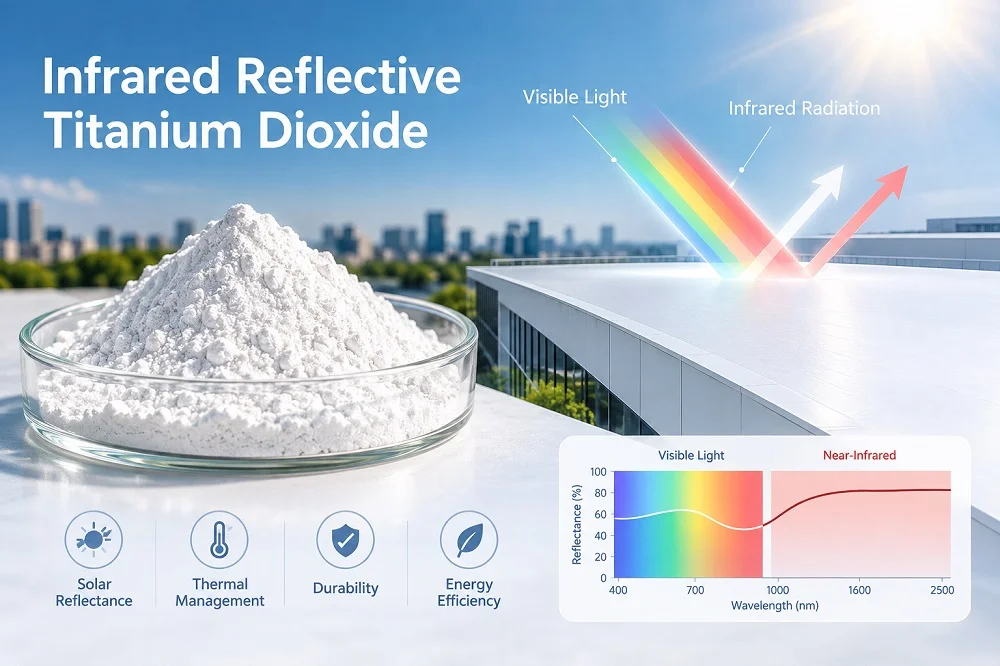
Infrared reflective titanium dioxide is a titanium dioxide-based pigment or functional material formulated to reflect a significant portion of infrared radiation while maintaining useful visible-light properties.
Solar radiation contains visible light as well as ultraviolet and infrared wavelengths. Infrared radiation, particularly near-infrared radiation, contributes significantly to the heating of exposed surfaces. When a coating or polymer system reflects more of this energy, less solar radiation is converted into heat at the surface.
This makes infrared reflective titanium dioxide useful in products designed for solar heat management, thermal control, and energy-conscious surface design.
How Does Infrared Reflection Work?
The performance of an infrared reflective pigment depends on its optical characteristics, particle properties, crystal structure, dispersion, and interaction with the surrounding binder or polymer.
When incorporated into an appropriate formulation, the pigment can scatter and reflect selected wavelengths of solar radiation. The actual infrared reflectance of the final product is therefore influenced not only by the pigment itself but also by pigment concentration, particle dispersion, film thickness, binder properties, and surface color.
Infrared Reflective Titanium Dioxide vs. Conventional Titanium Dioxide
Conventional titanium dioxide is widely used because of its high refractive index, strong visible-light scattering, opacity, and whiteness. These characteristics make it a standard pigment for paints, coatings, plastics, inks, and other products.
Infrared reflective titanium dioxide focuses more specifically on optical behavior in the infrared region.
| Feature | Conventional Titanium Dioxide | Infrared Reflective Titanium Dioxide |
|---|---|---|
| Main purpose | Whiteness, opacity, and visible-light scattering | Infrared radiation management and solar reflection |
| Key performance area | Visible spectrum | Visible and near-infrared spectrum |
| Typical applications | Paints, plastics, inks, coatings | Cool coatings, heat-management coatings, plastics, industrial surfaces |
| Formulation consideration | Opacity and color | Reflectance, color, dispersion, and film performance |
For buyers, this distinction is important because a pigment with excellent visible-light performance does not automatically provide the infrared reflectance required for a particular thermal-management application.
Key Properties of Infrared Reflective Titanium Dioxide
High Solar Reflectance Potential
One of the most important characteristics is the ability to reflect solar energy, particularly wavelengths in the near-infrared region. This property can contribute to reducing the amount of solar energy absorbed by a coated or pigmented surface.
Excellent Light Scattering
Titanium dioxide has a high refractive index, which allows it to efficiently scatter visible light. Depending on the grade and formulation, infrared reflective titanium dioxide can combine optical performance in the visible and infrared regions.
Good Opacity and Hiding Power
For coating and polymer applications, opacity remains an important consideration. A functional pigment that provides infrared reflection while maintaining suitable hiding characteristics can simplify formulation requirements.
Dispersion Performance
Uniform dispersion is essential for achieving consistent optical performance. Agglomeration can reduce the efficiency of the pigment and create variations in color, surface appearance, and reflectance.
Compatibility with Different Formulation Systems
Industrial users may incorporate infrared reflective titanium dioxide into architectural coatings, industrial paints, plastics, roof coatings, and other systems. The surface treatment and particle characteristics of the selected grade should therefore match the intended binder or polymer system.
Applications of Infrared Reflective Titanium Dioxide
Cool Roof and Reflective Roof Coatings
Roof surfaces are exposed to substantial solar radiation. Infrared reflective pigments can be incorporated into roof coatings to improve solar reflectance and reduce the amount of solar energy absorbed by the surface.
This is particularly relevant for commercial buildings, industrial facilities, warehouses, and other structures where roof temperature and heat gain are important design considerations.
Architectural and Exterior Coatings
Exterior walls and building surfaces can also benefit from solar-reflective coating technologies. Infrared reflective titanium dioxide can be considered for formulations where maintaining surface appearance while improving solar reflectance is important.
Индустриски премази
Industrial equipment, storage structures, metal components, and outdoor installations may require coatings with specific optical and environmental performance. Infrared reflective pigments can become part of a broader coating strategy for managing solar exposure.
Thermal-Management Plastics
Plastic products used outdoors can experience considerable solar heating. Infrared reflective pigment technology can be incorporated into selected polymer formulations to help control solar energy absorption.
Potential applications include outdoor components, construction-related plastic products, containers, profiles, and other products where surface temperature and solar exposure are relevant.
Automotive and Transportation Applications
Some automotive and transportation components are exposed to strong solar radiation. Reflective pigment systems may be evaluated for exterior parts, coatings, and other applications where thermal management is required.
Why Infrared Reflective Pigments Matter for Energy-Conscious Products
Surface color and solar absorption are closely related. Dark-colored surfaces can absorb substantial amounts of solar energy, while specially formulated reflective coatings can improve the management of incoming radiation.
Infrared reflective technology provides formulators with another approach to designing surfaces that interact differently with solar radiation.
For manufacturers developing energy-conscious building materials or outdoor products, infrared reflectance can therefore become an important performance parameter alongside color, durability, weather resistance, and coating adhesion.
How to Choose Infrared Reflective Titanium Dioxide
Consider the Target Wavelength Range
Buyers should first determine which portion of the infrared spectrum is relevant to their application. Near-infrared reflectance is particularly important for solar-reflective products because a significant portion of solar energy is located in the infrared region.
Ask suppliers for relevant spectral reflectance data rather than relying only on general claims such as “high infrared reflection.”
Check Particle Size and Distribution
Particle characteristics influence scattering, dispersion, opacity, and surface appearance. The appropriate particle size depends on the formulation and the desired optical performance.
Evaluate Surface Treatment
Titanium dioxide pigments may receive inorganic or organic surface treatments to improve dispersion, durability, compatibility, or other formulation characteristics.
The correct surface treatment should be selected according to the resin, coating system, processing conditions, and final application.
Review Dispersion Requirements
A pigment with good optical properties can still perform poorly if it is not properly dispersed. Buyers should evaluate dispersion behavior in their actual formulation rather than relying exclusively on laboratory data from a different system.
Request Technical Documentation
For industrial purchasing, technical documentation can be as important as the pigment itself. Depending on the application, buyers may request specifications covering particle size, TiO₂ content, surface treatment, oil absorption, pH, moisture, density, optical properties, and other relevant parameters.
What International Buyers Should Ask a Titanium Dioxide Supplier
When sourcing infrared reflective titanium dioxide internationally, procurement teams should evaluate both material specifications and supplier capabilities.
Technical Questions
- What is the titanium dioxide grade and crystal structure?
- What infrared or near-infrared reflectance data are available?
- What is the recommended dosage for different coating systems?
- What surface treatment is used?
- How does the pigment perform in water-based and solvent-based formulations?
- What dispersion equipment and conditions are recommended?
- Can samples be provided for formulation testing?
Supply and Commercial Questions
- What are the standard packaging options?
- What is the minimum order quantity?
- What is the regular production lead time?
- Can the supplier support long-term bulk orders?
- Is private labeling or customized packaging available?
- What export documentation can be provided?
These questions help buyers distinguish between a general pigment supplier and a manufacturer capable of supporting application-specific requirements.
Infrared Reflective Titanium Dioxide for Coating Manufacturers
For coating manufacturers, pigment selection should be evaluated as part of the complete formulation rather than as an isolated raw material decision.
The final infrared performance can depend on pigment loading, binder chemistry, coating thickness, colorants, fillers, dispersion quality, substrate, and surface condition.
For this reason, laboratory trials are recommended before large-scale production. A supplier that can provide technical data and application support can help reduce development time and improve consistency between laboratory and production batches.
Important Factors When Buying in Bulk
Consistency Between Batches
For industrial manufacturers, consistent raw material quality is essential. Changes in particle properties, surface treatment, or optical performance can affect the final formulation.
Quality Control
Buyers should ask about production controls, inspection procedures, and batch-to-batch testing. Consistent testing methods are particularly important when optical performance is part of the product specification.
Packaging and Transportation
Titanium dioxide is normally supplied as a dry powder, so packaging should protect the material from moisture and contamination during storage and transportation. Export packaging should also be appropriate for the intended shipping method.
Technical Support
For specialized pigments, technical support can be valuable during formulation development. Suppliers that can provide sample quantities, technical documentation, application recommendations, and troubleshooting support can make international sourcing more efficient.
Frequently Asked Questions About Infrared Reflective Titanium Dioxide
Is infrared reflective titanium dioxide the same as standard TiO₂?
Not necessarily. Both materials are based on titanium dioxide, but infrared reflective grades are selected or engineered for specific optical performance in the infrared region. Standard TiO₂ may be optimized primarily for whiteness, opacity, and visible-light scattering.
Can infrared reflective titanium dioxide be used in white coatings?
Yes. White coatings are a common area for solar-reflective technologies because high visible and solar reflectance can be combined with suitable pigment and coating formulations.
Can it be used in colored coatings?
Potentially, yes. However, the final solar reflectance depends on the entire color formulation. Dark or strongly absorbing pigments can significantly affect infrared performance, so the complete coating should be tested.
Does infrared reflective titanium dioxide reduce surface temperature?
It can contribute to reducing solar heat absorption when incorporated into an appropriately designed reflective coating or material. Actual temperature reduction depends on factors such as solar conditions, surface color, coating formulation, substrate, thickness, and environmental conditions.
How should buyers compare different grades?
Buyers should compare more than TiO₂ content. Relevant factors can include spectral reflectance, particle size, surface treatment, dispersion, opacity, weatherability, compatibility, and consistency between batches.
Заклучок
Infrared reflective titanium dioxide is an important functional pigment for manufacturers developing solar-reflective coatings, thermal-management materials, outdoor products, and energy-conscious building solutions. Its value comes from combining the established optical characteristics of titanium dioxide with performance requirements in the infrared region.
For international buyers, the right grade should be selected according to the complete application rather than a single specification. Spectral reflectance data, particle characteristics, surface treatment, dispersion behavior, formulation compatibility, quality consistency, and supplier support should all be considered during procurement.
If you are sourcing infrared reflective titanium dioxide for coatings, plastics, building materials, or other industrial applications, working with a manufacturer that can provide technical specifications, samples, stable bulk supply, and application support can make the qualification process more efficient.
Looking for an infrared reflective titanium dioxide supplier? Contact our team to discuss your application, required specifications, sample testing, packaging requirements, and bulk purchasing needs.
Поврзани производи
 Infrared reflective pigment
- Pigment Red 177 Buying Guide: Everything Importers Need to Know Before Purchasing
- Infrared cutoff pigment
- Infrared transmitting pigment
- Pigment Yellow 139: Properties, Applications, and Buying Guide for Industrial Buyers
- Што е пигмент црвена 146 и каде се користи?
- Зошто пигментот црвена 177 е идеален за боење на пластика и производство на мастербеч
- Pigment Yellow 110: Properties, Applications, and Buying Guide for Industrial Manufacturers
- Технички податоци за пигмент црвена 177: Отпорност на топлина, отпорност на светлина и хемиска стабилност
- Што е пигмент црвена 177? Објаснети својства, примени и придобивки